
Sunday, 10 June 2012

Saturday, 28 April 2012
Conwy River Project Update April 2012
 |
| Ceirian the Water Nymph |
Today saw another practice dive at Cobden’s Pool, Capel Curig, with Liz, Dave (Platt), Kathryn and Helen taking the plunge; and myself and Nigel acting as surface support. Ceirian, Liz’ daughter, arranged herself gracefully on various rocks, grassy banks and in trees, and did a good imitation of a beautiful water nymph.
After the heavy rain of the past week or so, we were concerned the river would be in spate, but the previous 24hours without rain saw the level falling, so that again, the maximum depth was 3ms in the defile under the bridge. However, the current was 1.5-2knots, and moving deeper than previously, making the swim upstream to the white water fairly strenuous.
This was followed by a drift downstream to the safety rope across the pool so all could practice grabbing it in the event of a current taking a diver out of control.
 A calmer exploration of the pool below yielded some interesting garbage – mostly iron drain pipes - which we salvaged and photographed for the record. This will be added to my scrappy pile to be cashed in one day.
WATCH THIS SPACE
 |
| Grap rope |
 A calmer exploration of the pool below yielded some interesting garbage – mostly iron drain pipes - which we salvaged and photographed for the record. This will be added to my scrappy pile to be cashed in one day.
We saw brown trout, minnows, freshwater sponges, mayfly larvae, milfoil, and grasses. As the water warms up and the juvenile fish start to appear, we will see more activity in the rivers, including eels, salmon, sticklebacks, smelt, stone loach, bullheads and various insects/ larvae/animalcules and freshwater flora.
There are otters in the Conwy, pearl mussels, freshwater shrimps, dippers, shrews and voles.
 |
| Conwy Falls and Fish Tunnel |
We have now explored the upper reaches of the Conwy as far downstream as Beaver Pool, where access allowed. We have met some interesting people and seen some beautiful sites, including the lake, gorges, waterfalls (Conwy Falls is spectacular and worth exploring), Victorian fish ladders, the fish tunnel by the Falls, deep pools and shallow meanders. Everyone has been very encouraging and eager to support the project. We have permission to dive the Conwy Falls area from the right bank, thanks to Ollie and Rebecca of Conwy Falls Hotel (who have an amazing selection of homemade cakes in their café!), and are waiting on permissions from Dwr Cymru, National Trust and Forestry Commission, as well as other landowners and those with riparian rights. Hopefully, the next dive will be in the Conwy River itself, and, along with the lake, Beaver Pool looks to be a prime introductory site. This pool is just outside Betws, downstream of Fairy Glen and the bridge by the Fairy Glen Hotel on the road to Dolwyddelan. I measured the depth of the water in the pool, and it comes in at a good 8ms. The site measures approx 50ms x 75ms with a variety of habitats.
Meeting at Four Crosses earlier in the week, Nigel Milner, our fisheries guru, gave us some useful tips on methods of surveying the river. As Liz and Kathryn between them have a good amount of experience and knowledge we should be able to provide some interesting material for all those supporting the project, including RSPB, CCW, Clwyd and Conwy Rivers Trust, Conwy Valley Fisheries, Conwy Falls Hotel.
We have a database of 36 potential dive sites along the Conwy. Kathryn has devised a Riversearch Observers record, on which to collect data about the sites, and we are looking at the possibilities of a grant for equipment that would be useful to the project and the club as a whole.
We have also applied for permission to dive various of the lakes in Snowdonia – the Gwynant, the Dinas, the Idwal, the Cwellyn and the Crafnant. All dives would be to note and photograph the underwater environment and ecology. These sites would be a useful addition to our options in the event of being blown out of the sea.
 |
| Otter swimming, courtesy Digital Nature Photography |
Please contact Carol, Liz or Kathryn if you're interested in helping with the project
And finally
 |
| It's the beans - honest! |
Sunday, 18 March 2012
Menai Straits March 18th 2012

Divers - Mike, Kevin, John, John [Gill], Nia, Gethin, Wojciech, Carol
Mike asked me to post some photos of anemones we found on the reef under the bridge, which I've attempted to name - but as there're so many that look very similar I could be totally wrong!


The 2 above - I think - are varieties of Sagartia elegans (Elegant anemone). They look a bit untidy and have thinner longer tentacles relatively than Dahlia anemone and were on rock, rather than on the gravel bed.

The rest are vary coloured Dahlia anemones as far as I can tell, with some interesting fauna around and near them. This is a very interesting site and I hope we dive here again - there is so much to see!


Friday, 16 March 2012
Diving at Cobden's

On Sunday 10th March, a hardy group of us set off to do our recce dive of the Llugwy - by way of training for the River Conwy project - at Cobden's Pool. Permission courtesy of Roland Jones, Prop. Cobden's Hotel. Access was via the little beach just below the carpark.
Equipment consisted of a variety of ropes that Liz mostly brought, including floaty ones, and a heavy one if needed. Mike brought a milk crate to lower the gear down to the beach, but as this was too small, we used an old rucksack and trussed it all up with carabiners and figure 8s, of which we had a carrier bag full. We had an interesting collection of grapples, if we decided to practice anchoring ourselves to the bottom (which we didn't) - including a short handled garden rake and a 3-tined handplough (! lethal), an ice axe, and various assorted other bent metal implements.
The first thing was to set up some grabropes in case the current was so strong we were swept downstream. Nigel (my other half) waded across various small tributaries and attached floaty ropes to trees and bushes.
That done, we lowered the gear down the wall onto the beach, devised the dive plan, and then it was 'Who's going in first?' The current looked pretty vicious - a couple of knots? - and from the bridge Liz measured the depth with a tagged rope as being 3ms....not exactly the deepest dive in the world, but that wasn't why we were doing it!
Mike and Kathryn took the plunge and as vis was quite good (at least 3ms!) we could see them swim down stream, past the grabrope (huh?!) to the large boulders guarding the ouflow.
"Are they going to get swept away??" Liz and I waited with baited breath......but as it was only about 1-2ms depth the only (?) hazard was going to be crawling on hands and knees with bums in air. There were some great shots of Mike's fins as he did a handstand.....sort of reminiscent of a whale's tail fin...but out of respect for Mike I have not included one here.....
Turning round, they then ventured into the midflow of the current and, standing on the bridge looking down, we could see them swim upstream, through the defile, under the bridge, right up to the white water rapids!
Then it was Liz and my turn. We didn't bother with the shallow bit, more interested in seeing how to deal with the current. We were pleasantly surprised to find that the current was only fast in the top metre of the water column and we could doddle about without much difficulty below that.

The 'landscape' below was very interesting, mostly blue/grey cobbles, and contorted bedrock covered extensively in places by green and purple algae. We followed channels through the boulders and bedrock, and Kathryn found a small fish under a stone (stone loach/juvenile trout?), Liz and Kathryn saw a juvenile trout hanging about by the beach, and there was a patch or two of white sponge deeper within the rocks, plus some weed and grass type flora.
 So not a lot of wildlife, at least, not on a cursory glance. And as our prime objective was to practice skills, we didn't do much hanging around quietly, which will be essential for seeing anything in the wild.
The prime beauty of the site for me was the sculpturing of the rocks by the currents and eddies into holes and chasms, in which interesting and colourful collections of pebbles had gathered.

It was exciting swimming up underneath the rapids and we got some great underwater footage of the white water swirling through and over the boulders. As we felt this would be a great incitement to others to plunge in with us, I have now learnt how to capture a single still frame from a video of rushing water...

During the dives we picked up litter - which included a bicycle bell, a tin can, a yoghurt top, a solar reflector...and underneath there were various heavy rusty iron artefacts that we couldn't identify.
All in all, over lunch at Cobden's hotel, we felt it was a successful recce, and apart from Nigel getting soaked in his riggers boots (not meant for underwater we decided), we felt heartened that we would be able to move on to the next stage, which is the actual Afon Conwy.
Kathryn is devising a recording form which anyone will be able to fill in after a dive, noting location, type of riverbed, flora and fauna and anything else of note.
The river dive project needs more divers and cameras, and more people willing to mess around on river banks with ropes and help get gear to the sites. The thought of summer banks, quiet splashing of voles and trout, and picnics, and pubs, springs to mind....as well as traipsing across moors and abseiling down gorges....anyone up for it?
Monday, 23 January 2012
An initial recce of the freshwater diving group (to go with pictures in Carole’s previous post)
Carol couldn't wait for further responses from Martin Doyle of Plas y Brenin and it was a lovely day the other Friday (13th) so I accompanied her to have a recce around the Afon Lligwy at Capel Curig (the potential site of our proposed river diving training)
We were both equipped with a map each - so no worries there!
We started by the Cobden's Hotel car park (all of this assumes permission etc. to clamber across fields, through woods, along footpaths etc.) Here there is very easy access to the water, a rush of water under the footbridge into a large pool, the river then divides around an island or two, to the right the water runs fast over shallow boulders, this might be a good site to see what speed of running water we can cope with as the entry point is out of the current. Also perhaps to creep towards the bottom of a waterfall and see what it's like with a safe get-out plan – (in case it's not nice).
The water was lovely and clear all along.
We played pooh sticks to time the rate of movement of water along approx. 10m, under this footbridge we got 0.7 knots or 0.8 mph - which sounds a lot slower that it looked!!
Further upstream there were more nice pools after lots of waterfalls (short ones) with possible access across fields from the roadside - or along the footpath on the other side which would be a longer walk.
In one of these pools immediately opposite the old garage with red frontage we measured a flow of 0.65 knots or 0.75 mph (figures for these sums gleaned from Wikipedia so they must be accurate - not to mention our guesstimate of what 10 metres looks like!)
Further upstream again, the banks were part of the Forestry Commission - Bryn Engan - including some mountain biking paths through the woods. By Plas Curig (as marked on the map) there was a new FC bridge and here we found a torn dry suit wrist seal lying on the path?????!!
Opposite the Bryn Tyrch there was what we decided was a riffle bit with an area of calmer water which might be deeper.
We also went to Plas Y Brenin and looked at their canoeing pool - which also looked like a good site but might be very shallow.
Hopefully we'll get more info from PyB people about depths of the water here and there, when we do our survey of the Conwy we will include shallow waters where crawling/wading is required.
The main obvious hazards we noted along this stretch were boulders and tree branches in the water
Thoughts about techniques/equipment etc. as we went along were:
For initial recce's of sites we would need a plumb line (marked in depths) to use from bridges etc.
Ropes could be used for a number of purposes:
- a weighted line for an underwater transect (as used in underwater surveys we've done at other places)
- a line across the river on the surface to catch divers swooshing off unexpectedly in the wrong direction
- a line along a piece of bank for a diver to grab and pull along if examining a short section by a bank
Also initial or second visits - just snorkelling may be best to then decide whether SCUBA gear would be appropriate
Wheel barrows and trolleys would be useful for humping gear
If we used some sort of grapple we would need to consider what if any damage this might do to the bottom - an initial snorkel might confirm whether a grapple would be of any use anyway.
It's going to be handy to have lots of shore cover
Errr - that's it
Lig
Wednesday, 18 January 2012
Source to Sea – an underwater ‘travelogue’ of the River ‘Conwy’ From Llyn Conwy – Merddw confluence – Lledr confluence – Llanrwst - Conwy Estuary
Prompted by a generally expressed interest in extending our club diving possibilities in winter, and even during periods of bad weather at sea in the summer, at our last club committee meeting in November, Tristan Hatton-Ellis, Fresh Water Officer for CCW, spoke with enthusiasm about how we might informally collaborate with CCW regarding producing some interesting and, hopefully, artistic and inspiring photographs of various fresh water sites in Anglesey and Gwynedd. He talked about green fresh water sponges in Llyn Idwal, for instance, and many other unique aspects of our beautiful rivers and lakes, inspiring us with enthusiasm to go forward.
So, a couple of Sundays ago, a
group of us met in the Panton Arms at Pentraeth to chat about the possibilities
of fresh water diving. With us was Nigel Milner, Fisheries Scientist, a
once-member of the club, and a member of the Conwy and Clwyd Rivers Trust.
 |
| Llugwy Widens |
To begin with we were considering both lakes and rivers, and Snowdonia
National Parks have given us permission in principle to dive Llyn Tegid (Bala).
 |
| Across pool below Cobden bridge |
However, after last night’s meeting we came away with the beginnings of
an exciting project, that to our knowledge has never been done before in the UK
(I stand to be corrected here…) – which is to dive the length of the River
Conwy, and produce an underwater ‘travelogue’, consisting of written records,
slides and videos of the various environments encountered – riffles, pools,
gorges, waterfalls, tidal reaches etc., ranging from a couple of meters only to
5-10 meters deep, and the aquatic life, both plant and animal, that we hope
flourishes in them. Not dissimilar to Seasearch in that aspect. On the way
we’ll be learning about invasive species that are threatening native ones, how
not to cross contaminate, and how to dive with and against the flow in fairly
fast moving water at times. We will obviously use our well- won judgement from
diving in the sea, and keep well clear of those places which look too
dangerous.
 |
| View of defile under Cobdens bridge |
We are now in the throes of researching everything we need to know about
river diving and pulling in the experience of BSAC HQ, in the person of Jim
Watson, Safety and Development Manager; old and new members of the club; and
environmentalists from all corners of the two counties, this to produce an
overall plan/presentation, templates for risk assessments, set up a programme
of safety and skill training sessions, walk the banks, talk to angling
associations and landowners, get permissions to dive, and generally get to know
Afon Conwy.
We have walked the banks of Afon Lligwy in the meantime, which looked to
be a suitable training site, with a wealth of information we could tap into
from Plas y Brenin. Nina is setting up a template for risk assessment, both for
general hazards and specific sites; Liz is working on a presentation we can use
for other concerned organisations about the club and its history and activities
to date, Mike is working on equipment and skills/techniques needed, Kathryn is
providing us with information about biodiversity in the rivers and intertidal
areas, and Nigel is helping us with general info about the Conwy and its
waters, plus permissions and introductions to interested people/organisations.
 |
| Rocky section upstream of Cobdens bridge |
We will hopefully come away from such a project with a wealth of new
skills and experiences, and material which will serve to raise awareness both
of ourselves and the general public about the largely unseen life in our
rivers, the threats to that life from pollution and hazards from tipping, and
how important all water is to life’s continuing existence.
Please get in touch with one of the following club members (telephone/emails
available from list of club members previously updated and distributed by
Helen) if you’re interested in taking part in this project, which we hope to
get underway by the spring. Besides divers of varying adventurousness, we will
need shore - I mean ‘bank’ – support crew, so there’s a role for everyone.
We will be calling another meeting for those of you who are interested
in the next couple of weeks, and brief field trips to reconnoitre both the
Lligwy and Afon are anticipated, before we take the plunge and start skills training.
Thanks
Liz Healey
Kathryn Birch
Mike McCann
Nina Hamilton
Carol Horne
Saturday, 13 August 2011
Dive Trip Skomer 2011

Myfyr, Mark, Kevin and Carol enjoy a cuppa courtesy of the Skipper!
 The Skomer 11 head off to the pub!
Many thanks to Mike McCann for organising. It was a great few days diving and the weather was FAB!
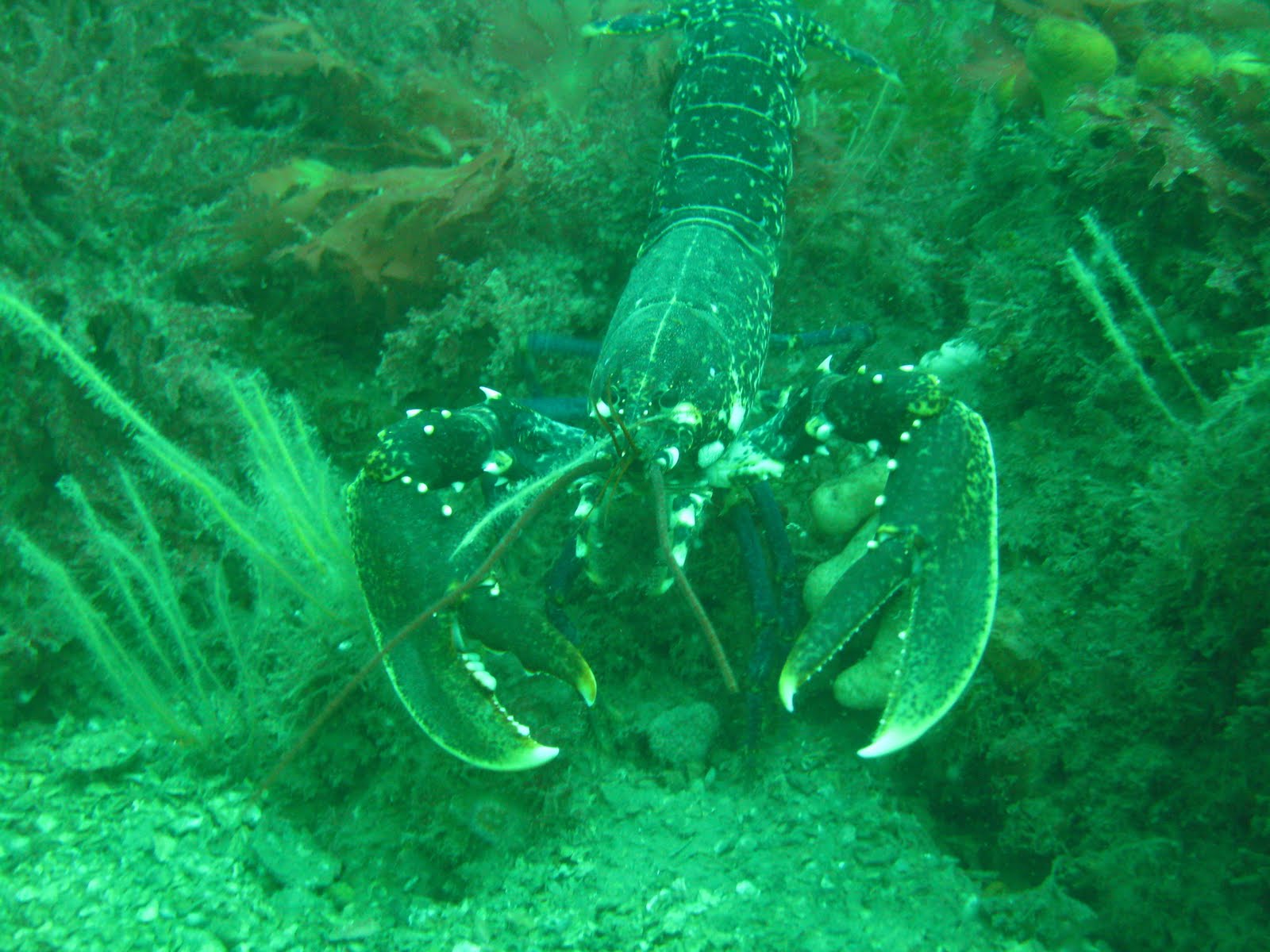 Vis was really good - a luxury we're not used to!!
Subscribe to:
Posts (Atom)